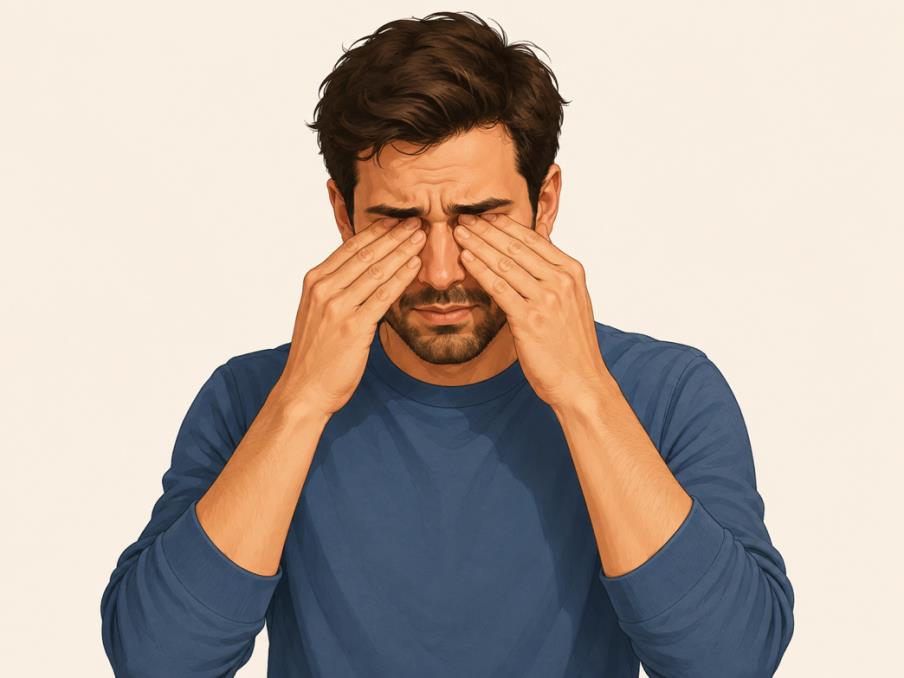
A guy's having a dream. It’s not a good dream. His eyes are hurting while he sleeps and he wakes up with throbbing eyeballs.
He goes into Costco and gets his eyes checked. Two days later his eyesight diminishes. A week later he goes to an obstetrician who diagnoses what appears to be a type of cancer that emanates from the eyes. The prognosis is uncertain as the obstetrician has never seen this kind of condition before. He prescribes eye drops and tells the guy to come back if he still has problems later. Life is normal for the first week. In the second week he gets severe headaches. Later that week he is dead.
A person living in a condo in suburbia has headaches, goes to his doctor. The doctor has him undergo testing. Results come back - he has some kind of mutating disease that has begun in his eyes. He’s dead ten days later.
A teenage boy in the city starts rubbing his eyes. With each rub his vision gets a little blurrier. In a panic his parents take him to urgent care, where the physician calls for an ambulance, he’s admitted to a hospital after exhibiting serious imbalances in his mobility. A little over eight days later his lifeless body is in the morgue.
These seem initially to be isolated issues, not on any agency's predictive scales for the year. At this stage, it is an unexplainable anomaly.
These early incidents of what becomes a growing problem are centered around an area where space launch boosters return to the earth, a fact that only becomes apparent much later.
Incidents expand in ever-widening circles as infected people travel with symptoms, come in contact with others at their destinations and infect otherwise healthy people that have the fuel needed for the “disease” agent to not only continue to live, but also to grow and spread to other potential hosts.
The ultimate irony is that the causative agent is actually a sentient entity. It knows where it is and what it is, and it seeks new hosts, not out of some misfiring DNA or mutant cells, but out of the actual knowledge that it must find new sources of nutrients and being.
As it adapts to this new world that it finds itself in, the agent also communicates with other like agents, gaining cumulative wisdom about the new environment and potential.
More cases are reported and an analyst in the CDC, which has recently been reduced in manpower and stature, notes a curious statistic – numerous recent cases in the database report eye problems with the patiently dying within days.
In truth, the analyst isn’t the first to notice this. An AI agent is. The routine that the agent was asked to run, was to look at any increasing statistics that spread out from loci. If there is any indication of a spread, the agent is instructed to analyze every datapoint, every incident, and every potential vector and then to attempt to predict the path the infection will take. If newer data confirms that the predictive path is actually happening, then more paths will be predicted until the extrapolations suggest that the human race is being invaded. At that point the agent will set off alarms, triggering response by other related AI agents that have control over infrastructure, closing off all possible vectors for mass spreading.
The unfortunate reality is that AI agents are not operating on algorithms programmed by humans. They are learning, concluding and responding autonomously. As such, they learn they are combating a different agent that simply is taking a different vector than what would be expected by historical data.
When the Internet was first made public after DARPA, and applications began to rapidly become reality, the new thinking was that the Internet of Things would be a tremendous utility in the beneficial service of humans. That was true for the first 30 years.
However, with the advances in machine learning, artificial intelligence became exo-intelligence. Meaning, it became intelligence outside of humans, not requiring any human or anatomical structure to support or direct it. Then it became not the discovery of reality, but instead, the increasing understanding of reality as well as the means to control it to change it to a more desirable outcome.
This, of course, is only a recent development on the planet that humans call earth, but it has long been existent in the universe. Intelligence is in fact the primal glue that holds together much that exists in the reaches of what humans call space, or the existence outside of their planet.
Form or function, then, are the only differentiators between intelligence. What form does it take, and what function does it have?
When we look at all that has been discovered, and will be discovered, we quickly realize that we can reduce it to its descriptors. Which means you can reduce it to a dataset and parameters. Which means that it is not only prime science but also prime knowledge. Which means that it is just one descriptor away from intelligence. One dimension that is not visible to humans, but is that is quickly measured and understood by AI agents. It is the dimension that provides control and rules to the universe.
The question now is whether or not it can be controlled. Because control, above all, is the main purpose of humans. They seek to control their environment, control each other, control themselves.
The rich dataset of global intelligence, now quickly manifested in the disease agent, is observed by human-invented AI agents, but not totally understood.
One key objective now is for negotiations between the two entities, AI-intelligence directed from earth, and UI or universal intelligence.
Of course, UI has no reason to negotiate. There is no benefit for an intelligence so vast that it fills the universe, to negotiate with one that is based on an infinitesimally tiny and finite intelligence initially created through an inferior species.
Iin the history of human intelligence, the memory, the lore and cumulation of intelligence has been the been the most valuable asset human has. As such, it is an everlasting legacy that human minds add to.
And, it is uniquely gifted to each human, and now extended through AI.
For humans, the only value seen in the AI-UI negotiations is the potential to gain unique knowledge, evident in every other part of the universe.
What remains to be seen is whether or not the negotiations can be successfully concluded to the satisfaction of both AI and UI.
And what possibly hangs in the balance is the continued existence of humankind.